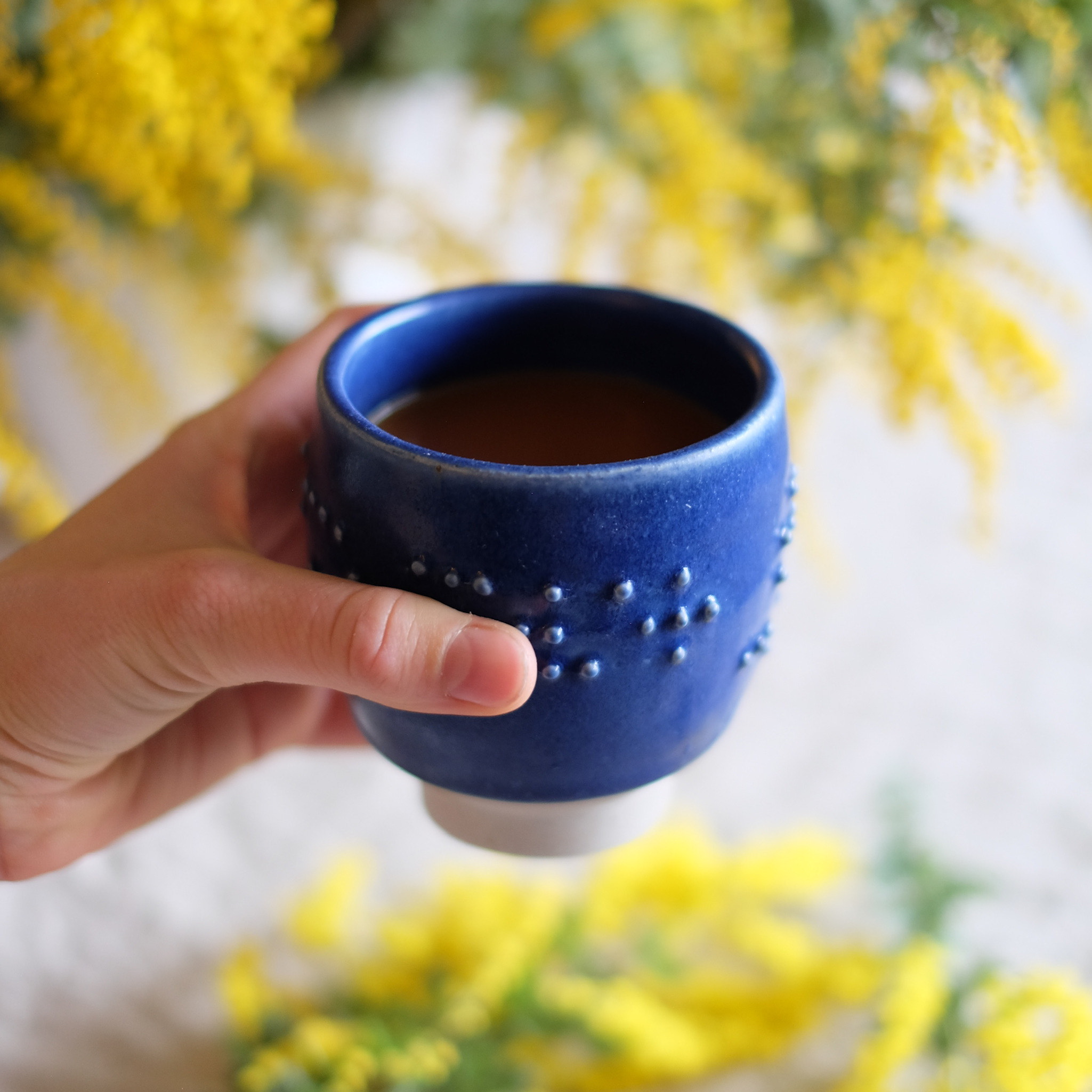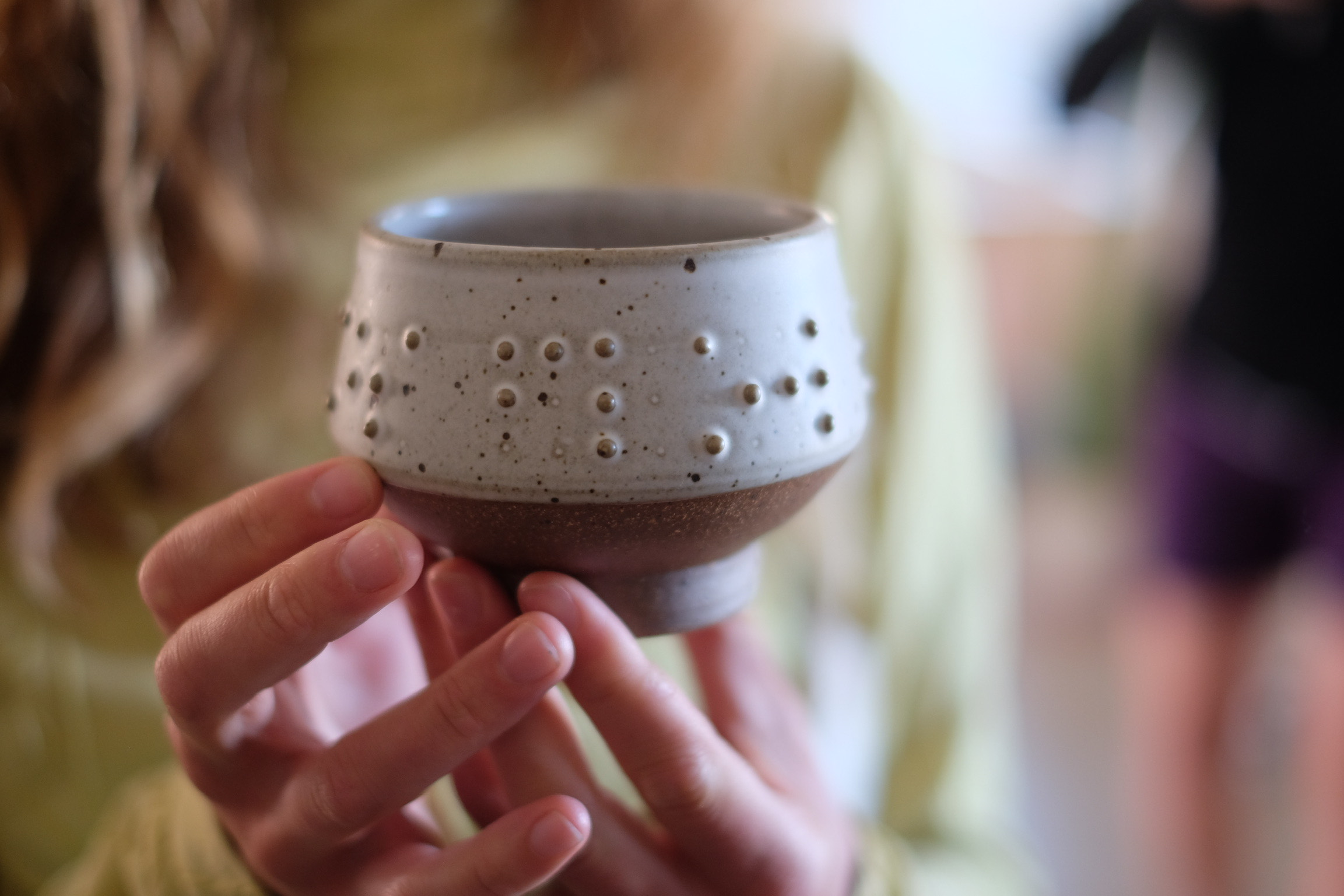

Do your cupboards have sweet, handmade tea cups? Hearing about artists’ stories is a treat. To honor this, we’re sharing our interview with Michelle Tanberg, our current teaware potter.
How and when did you come to clay?
I played with clay earlier, but when I was studying music at the University of Montana, the ceramics studio became my hide-out haven and playground. The demand to perform in academia was overwhelming. I could put months into practicing my instrument, only to flub the live performance because of a memory slip or nerves. I found that if I spent months in the ceramic studio, the outcome was tangibly fruitful, with an overflow to show for it. These stacks of bowls could theoretically last two thousand years beyond my life. This was satisfying, so I spent all my extra time in “clay therapy.” It quickly became a second focus of study.
How has your upbringing influenced you as a maker?
I come from a family of makers. I saw how almost anything can be an opportunity for, and expression of, craftsmanship. With a craftsman–builder father and an architect–designer mother, I grew up with a drafting table next to the dining table. Our own home was in a constant flux state of half-finished remodel, with construction sites as my siblings’ and my playground. We all worked on my father’s log home early on as trowelers. Here, the emphasis on correctly following “The Process” was instilled. We learned an appreciation for working with one’s hands, as well as the importance of following the best steps, taking time to make a good product, because sloppy shortcuts lead to poor craftsmanship—and potential danger (a careless spill could lead to a slippery ladder rung, etc).
My mother taught us to notice beauty, play, and freedom. Our father taught us to pay attention, and open our eyes to the details. From the food on the table, to the table itself, we understood and celebrated creating something from scratch. You have a need or desire, you dream up a design, and then experiment and play to produce a product.
Braille is a beautiful, textural surface choice. What led you to adding it to your surfaces?
Ceramics and clay speak eloquently and boldly in the language of touch. One should appreciate the aesthetic of a form without necessarily seeing it, simply holding a vessel in hand.
I met my friend Grace in university orchestra ten years ago. She was a violinist who received her certification in teaching Braille to visually impaired children. I studied both double bass and ceramics. I had chosen “texture as a language” for my advanced research project in the ceramic studio, and mused on translating that into clay. Through listening to Grace tell her own life experiences, and the discoveries she made in teaching, the inspiration for “Braille Bowls” was born. Initially, I wanted to teach myself Braille slowly through writing secret messages, most of which are short poems and hopeful offerings.
We experience our surroundings with different senses, giving us a new perspective on the wonder around us. Grace would probably correct me, saying that Braille is technically a “code” and not a true language because it cannot be spoken audibly. However, I would say that communicating and deciphering through touch is an incredible skill to be celebrated. I want to encourage people to feel things differently, to slow down, taking the time to be challenged, and crack a hidden message. I want people to consider seeing and reading through their fingertips, as others have learned from necessity. Most of all, I want us to appreciate our gift of sight, and also the profound beauty of touch.
What draws you to making functional wares from clay, rather than sculpture?
When you make a pot, you have people in mind. When you sculpt, it’s more a form of storytelling, welcoming interpretations to continue the idea onward. You intentionally make a vessel for someone, considering their lips and hands, in the event of serving their needs. A sculpture is a wild thing, and may not be meant to be held, but often observed.
I have boxes upon boxes of little sculptures I’ve made. There’s a series of miniature ceramic “character busts” which I had great joy in forming. I have yet to find an appropriate avenue for them to be introduced into the world. Pots introduce themselves, and people readily invited them home. I’ve been more focused on functional vessels because they go farther, faster. They connect the dots from potter to public—held in the hand, cherished, serving others.
What does a day in the life of a potter look like for you?
I have a seasonal outdoor studio off the back stoop, with one wheel in the sun, and one in the shade under an elaborate temporary tarp structure. I play Classic FM radio, jazz, or opera; sometimes sermons and scripture readings, audio books, poetry podcasts, or just silence. When I trim, I need to focus on not blowing out the foot of a pot. Listening to a novel can lead to bottomless bowls for me! If I can’t hear the wheel turning, I go too far.
A pile of cookies, endless tea, taco breaks inside, the constant fight to keep larch needles off of every surface, and the serious battle with the squirrels leaving tracks across my wet clay—they have an insatiable curiosity for mischief!
In the late fall, when I can’t keep my heat dish and wheel head warm enough to work on (pouring boiling kettle water over every so often), I enroll at FVCC (Flathead Valley Community College) for a clay class, happily rejoining the community of neat folks who create there. It is a welcome change to working alone. But I enjoy having both my own space for a time, and then having the input and creative juices of others abound. Often in winter, I find, we need more light from others. I dream about having an art house studio with a real roof someday!
What are your key influences/inspirations from outside the arts?
All creation and created things, especially the garden, are life-giving forms of beauty to absorb and enter into. Wouldn’t you choose to spend your days in an orchard garden if you could? The music and birdsong, the perfume and flavors, the light filtered through leaves, the creatures to meet and observe, the textures and colors and wholeness found there. We were meant for the garden from the beginning. I find much inspiration being surrounded by growing, fruitful life. Even in the doldrums of winter, I go there in my imaginings.
What are your personal favorite vessels for drinking tea and why?
I love the form of the tea bowl. Drinking from a tea bowl is an intimate experience, cupped in palms. This vessel begs for a non-rushed ritual of sipping. You must consider how to move with one, without a giant handle to hold while flying out the door on a commute. Tea bowls give quiet invitations to rest and reflect, while holding warmth. If I could make just one thing from here on out, it would be tea bowls.
Which teas are you into right now?
I enjoy Lake Missoula Tea Company’s Apricot Green tea. It embodies everything a pleasant summer should hold: a golden smooth flavor, and juicy goodness from the garden. I went on a tea splurge, led by sniffing the entirety of wonderful tester jars in the shop, and discovered Sticky Rice Puerh to be like nothing I’ve ever tasted before: a fermented tea with a savory comfort. I normally gravitate towards floral notes in teas this season.
Interview by Lindsey Tucker, Edited by Boo Curry and Heather Kreilick
Category: Missoula Tea Shop